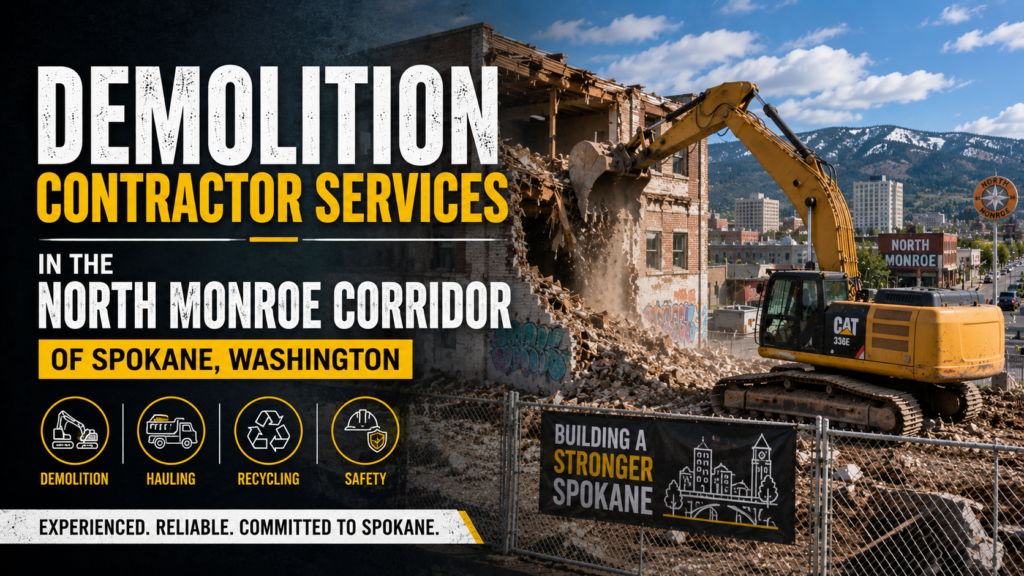
The North Monroe corridor in Spokane, Washington is one of the city’s most recognizable commercial and residential corridors a mixed-use street running north from downtown through established neighborhoods including Emerson-Garfield and into the broader North Spokane residential fabric. The corridor has been the subject of significant planning attention and revitalization investment in recent years, including streetscape improvements and land use updates that reflect North Monroe’s evolving role in the city. Within this context, Demolition Contractor North Monroe services play a practical and ongoing role in the corridor’s redevelopment cycle.
North Monroe: A Corridor in Transition
North Monroe Street serves as the main commercial spine for a series of residential neighborhoods that span from downtown Spokane northward. The corridor’s building stock reflects decades of layered development early twentieth-century commercial buildings, mid-century retail construction, and various residential structures abutting the commercial frontage. Many of these buildings have aged significantly, and as property owners and developers respond to the corridor’s revitalization momentum, demolition is frequently a necessary step in the improvement process.
Spokane’s 2017 North Monroe Street Project brought significant infrastructure investment to the corridor, and the subsequent increase in development interest has driven a corresponding increase in demolition activity as older structures make way for updated commercial uses, mixed-use buildings, and residential infill.
Types of Demolition Common on North Monroe
The mix of building types along the North Monroe corridor generates a variety of demolition project types:
- Interior selective demolition: Commercial spaces undergoing renovation typically begin with interior demolition removal of finishes, partitions, drop ceilings, flooring, and mechanical systems to expose the structural shell. This is the most common type of demolition on the commercial portion of the corridor.
- Full structural demolition of commercial buildings: Older commercial structures that are not candidates for renovation are removed entirely to clear space for new construction. These projects require the full permit and abatement sequence applicable to commercial demolition in Spokane.
- Residential teardowns: Single-family homes and small multifamily structures adjacent to the commercial corridor are periodically removed as part of development land assemblage or simply because the structure is beyond practical repair.
- Garage and accessory structure demolition: Detached garages, storage buildings, and accessory structures in the residential areas flanking the corridor are frequently removed as part of property improvements.
Permitting and Regulatory Requirements in Spokane
Demolition in the North Monroe area whether commercial or residential is subject to the City of Spokane’s demolition permit requirements administered through the Building and Planning Department. Key regulatory requirements include:
- Demolition permit application: Required for all structural demolition. The application triggers review by relevant city departments and, under Spokane’s Neighborhood Notice ordinance, notification to the neighborhood council in which the project is located.
- Asbestos survey and abatement: Washington State law requires that any structure built before 1980 be surveyed by a licensed asbestos inspector before demolition. If asbestos-containing materials are identified, abatement by a certified contractor must be completed before structural demolition begins. Most structures on the North Monroe corridor that predate 1980 will require this survey.
- Utility disconnection: All utilities must be confirmed disconnected before demolition work begins. This includes coordination with Avista Utilities for gas and electric service and the City of Spokane Water Department.
- Stormwater management: For demolition projects that will disturb significant ground areas, stormwater management practices may be required under Spokane’s municipal stormwater ordinance.
Working in a Mixed Commercial-Residential Environment
The North Monroe corridor’s mix of active businesses and occupied residential properties creates a specific operational context for demolition contractors. Work hours, noise management, dust control, pedestrian safety, and maintenance of access to adjacent businesses and residences are all significant operational considerations.
Professional demolition contractors working on North Monroe are experienced in:
- Maintaining pedestrian safety with appropriate fencing, signage, and walkway protection.
- Scheduling the noisiest work phases during hours least likely to impact adjacent residences and businesses.
- Managing dust with water suppression to protect neighboring properties and the commercial streetscape.
- Coordinating traffic management to minimize impact on North Monroe’s vehicle and pedestrian traffic flow.
These operational practices reflect both professional responsibility and the requirements of Spokane’s municipal code governing construction activities in mixed-use corridors.
Historic Preservation Awareness on North Monroe
While North Monroe is primarily a commercial corridor rather than a designated historic district, it does contain structures of historical and architectural significance. Spokane’s Historic Preservation Office reviews demolition permit applications that involve properties identified as potentially significant, and the City’s neighborhood notice requirements ensure that demolition proposals receive community visibility before work begins.
Demolition contractors working in historically sensitive areas of the North Monroe corridor should be prepared to coordinate with Spokane’s historic preservation review process when applicable, and to recognize that some structures along the corridor may be subject to additional review requirements beyond standard permitting.
Post-Demolition Site Preparation
After demolition on the North Monroe corridor, the cleared site must be properly prepared for its next use. This involves removal of all debris, appropriate handling of any foundation or sub-surface materials, rough grading to establish drainage away from the site and any adjacent structures, and stabilization of the exposed ground with appropriate erosion control measures.
For sites intended for new construction, sub-surface investigation of soil conditions and any potential contamination from prior uses is appropriate before new development planning proceeds. Experienced local contractors can coordinate this investigation as part of the post-demolition scope of work.
Conclusion
Demolition contractor services on the North Monroe corridor are a professional, regulated, and community-aware service that supports the ongoing revitalization of one of Spokane’s most important commercial streets. From interior selective demolition for commercial renovations to full structural teardowns for development land assemblage, the work is shaped by Spokane’s permitting requirements, Washington State’s abatement laws, and the practical realities of operating in an active mixed-use corridor where neighbors, businesses, and pedestrians are all directly affected by how demolition work is conducted.